
Chinese consumer brands flood into Africa as old investment model fades and exports jump 28%
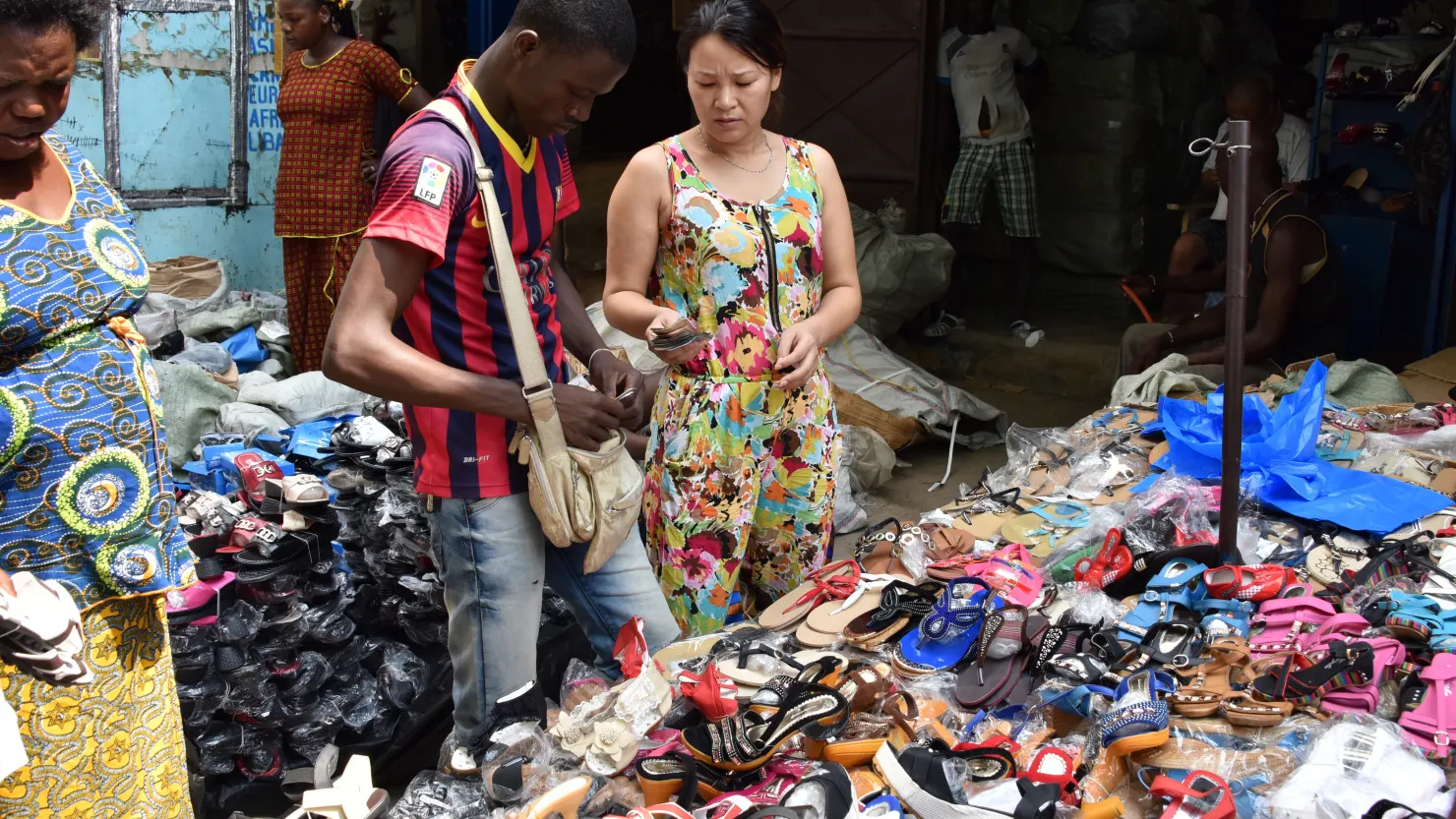
A picture taken on December 8, 2014 in Abidjan shows a Chinese shoe dealer in a transaction at Adjamene’s market.
Chinese engagement in Africa is undergoing a significant transformation, shifting away from large-scale infrastructure and resource extraction toward consumer goods and private sector investment. This strategic reorientation reflects both Africa's growing consumer class and changing economic priorities in China.
While Africa's overall GDP growth is projected at 4.1%, outperforming economies like Uganda (6.4%) and Zambia (5.8%) present attractive opportunities. According to a Rhodium Group report, Chinese investments in Africa's resource sectors have fallen roughly 40% since their 2015 peak. Conversely, China's exports to Africa surged 28% year-on-year in the first three quarters of 2025, dominated by higher-value manufactured goods like electronics, plastics, and textiles.
The Rise of the African Consumer
"In the early days, Chinese companies... were doing a lot more infrastructure and natural minerals mining," said Joe Ngai, Chairman of McKinsey Greater China. "In the last few years, I think people are trying to think of the African consumer market." This shift is visible in the expansion of companies like smartphone maker Transsion, telecom giant Huawei, and appliance manufacturer Midea, which recently signed an agreement with the Confederation of African Football.
The trend is amplified on Chinese social media platforms like Xiaohongshu and Bilibili, where entrepreneurs share experiences in sectors ranging from bubble tea shops in Kenya to electronics trading in Nigeria. While some success stories may be exaggerated, they reflect growing entrepreneurial interest in Africa's emerging markets.
Beyond Exports: Local Production and Deeper Integration
Euromonitor International notes that household spending across Africa is projected to exceed $2 trillion by 2030, driven by rapid urbanization and a connected youth population. However, analysts caution against a purely extractive export model. "It'll be necessary to see Africa as not just a consumer market, but as a market that produces the goods that the continent itself will consume," said Ebipere Clark of the African Policy Research Institute.
Some Chinese companies are already moving toward local production. Guangzhou-based Sunda International has established over 20 production centers in Africa over the past decade, generating up to $450 million annually from necessity markets like diapers and sanitary pads. This aligns with broader pushes for industrialization, as Chinese light manufacturers explore relocating to Africa—partly to gain preferential access to U.S. and European markets.
Structural Challenges and Geopolitical Context
The shift occurs amid high-level diplomatic engagement, highlighted by Chinese Premier Li Qiang's attendance at the recent G20 summit in South Africa. While increased use of the Chinese yuan in trade settlements (now around 30%) may reduce transaction risks, analysts note a "structural ceiling" due to China's trade surplus with most African partners and the enduring dominance of the U.S. dollar.
Rhodium Group also warns of a "stagnation scenario" where Chinese overcapacity and trade barriers in the West could flood African markets with low-cost exports, potentially undermining local manufacturing—a tension that will test the sustainability of this new phase in China-Africa economic relations.