Warehouse Cleaner: 5 Signs You're Underpaid (And How to Find a Better-Paying Job Today)
You push a scrubber through a freezing warehouse at 4 AM. Your back aches. Your boots are soaked.
You've been a warehouse cleaner for months – maybe years – and you're starting to wonder: is this really what the job pays? Here's the truth that most cleaning contractors won't tell you: industrial warehouse cleaning pays very different rates depending on who you work for, what shift you work, and whether you're directly employed or subcontracted. If you're earning minimum wage while doing heavy industrial cleaning, you're likely being underpaid.
This isn't another "how to clean a warehouse floor" article. Instead, we'll show you the 5 signs you're underpaid, how to find better-paying warehouse floor cleaning jobs, which industries pay the most, and how to spot exploitative contracts before you sign.
Part 1: The 5 Signs You're Underpaid as a Warehouse Cleaner
Sign #1: You're earning minimum wage (or close to it)
As of July 1, 2024, the Australian national minimum wage is $24.10 per hour or $915.90 per week. If you're earning $24.10-$25 per hour doing heavy industrial warehouse cleaning (operating scrubbers, handling chemical cleaners, lifting debris), you're at the bottom of the pay scale. Many warehouse cleaners earn $28-$35 per hour, especially on afternoon or night shifts.
Sign #2: You're not getting shift penalties
Warehouse cleaning often happens outside normal hours – early morning, night, or weekend. Under the Cleaning Services Award 2020, you may be entitled to shift loadings:
- Evenings: 15% loading
- Nights (after 7 PM): 20-30% loading
- Saturdays: 50% loading (first 2 hours), 100% thereafter
- Sundays: 100% loading
If you're working nights for $24.10 with no loading, you're losing hundreds per week.
Sign #3: You're a subcontractor but treated like an employee
Some cleaning contractors misclassify workers as "subcontractors" to avoid paying superannuation, sick leave, annual leave, and workers' comp. If they tell you when to start, what equipment to use, and how to do the job – you're probably an employee, not a subcontractor.
Sign #4: You're paying for your own equipment and chemicals
Legitimate employers provide industrial scrubbers, chemicals, PPE (gloves, boots, hi-vis vests, safety glasses). If you're buying your own, your pay needs to be significantly higher to cover those costs.
Sign #5: No penalty rates for overtime
If you regularly work more than 38 hours per week and don't get overtime rates (150% for first 3 hours, 200% thereafter), you're being underpaid.
| Sign | What You Should Be Getting |
|---|---|
| Minimum wage only | $28-$35/hr for industrial cleaning |
| No shift penalties | +15-30% for nights, +50-100% for weekends |
| Misclassified as subcontractor | Employee benefits (sick leave, annual leave, super) |
| Paying for equipment | Employer must provide PPE and chemicals |
| No overtime | 150%-200% for hours over 38/week |
Part 2: What Industrial Warehouse Cleaning Actually Pays (2026)
Industrial warehouse cleaning rates vary by shift, location, and employer type.
Direct employment (cleaning company employee):
- Day shift (6 AM – 2 PM): $24-$28 per hour
- Afternoon shift (2 PM – 10 PM): $28-$32 per hour (includes shift loading)
- Night shift (10 PM – 6 AM): $32-$38 per hour (includes night loading)
- Weekend shifts: $36-$50+ per hour
Subcontractor (ABN, own equipment):
- Day shift: $35-$45 per hour (but no sick leave, annual leave, super)
- Night shift: $45-$60 per hour
- You must factor in equipment, insurance, and tax
Direct employment with a warehouse (not a cleaning contractor):
Large warehouses (Amazon, Coles, Woolworths, Aldi distribution centres):
- $28-$35 per hour + benefits (annual leave, sick leave, super)
| Employment Type | Day Shift | Afternoon Shift | Night Shift | Benefits |
|---|---|---|---|---|
| Cleaning contractor (employee) | $24-$28 | $28-$32 | $32-$38 | Annual leave, sick leave, super |
| Subcontractor (ABN) | $35-$45 | $45-$55 | $55-$70 | None |
| Warehouse direct (Amazon, etc.) | $28-$35 | $32-$38 | $38-$45 | Full benefits |
Part 3: Where to Find the Best-Paying Warehouse Cleaner Jobs
If you're ready to move on, here's where to look.
1. Large distribution centres (Amazon, Coles, Woolworths, Aldi, Metcash)
These employers pay above award, offer benefits, and often have in-house cleaning teams (not contractors). Search "warehouse cleaner Amazon" or "distribution centre cleaner Coles".
2. Cold storage and freezer warehouses
Working in below-zero temperatures pays significantly more. Expect $30-$40 per hour plus freezer allowances (extra $2-$5 per hour). Examples: Lineage Logistics, Americold, Tolsma-Grisnich.
3. Manufacturing and food processing plants
Factories that produce food, beverages, or pharmaceuticals need rigorous cleaning. Pay: $28-$38 per hour. Examples: Nestlé, Coca-Cola, Fonterra, Goodman Fielder.
4. Government and defence warehouses
Defence warehouses and government logistics centres often pay above award. Check APSjobs.gov.au or Defence Australia recruitment.
5. Unionised cleaning contractors
Unions like United Workers Union have negotiated better pay for cleaning awards. Look for contractors that are signatories to enterprise agreements.
| Employer Type | Typical Pay | How to Find |
|---|---|---|
| Amazon/Coles/Woolworths DC | $28-$35 | Company career pages |
| Cold storage | $30-$40 + allowances | Seek, Indeed |
| Food manufacturing | $28-$38 | Industry job boards |
| Government warehouses | $30-$40 | APSjobs.gov.au |
| Unionised contractors | $28-$38 | United Workers Union website |
Part 4: Warehouse Floor Cleaning – What the Job Actually Involves
Warehouse floor cleaning is not the same as office cleaning. Here's what employers expect.
Daily tasks:
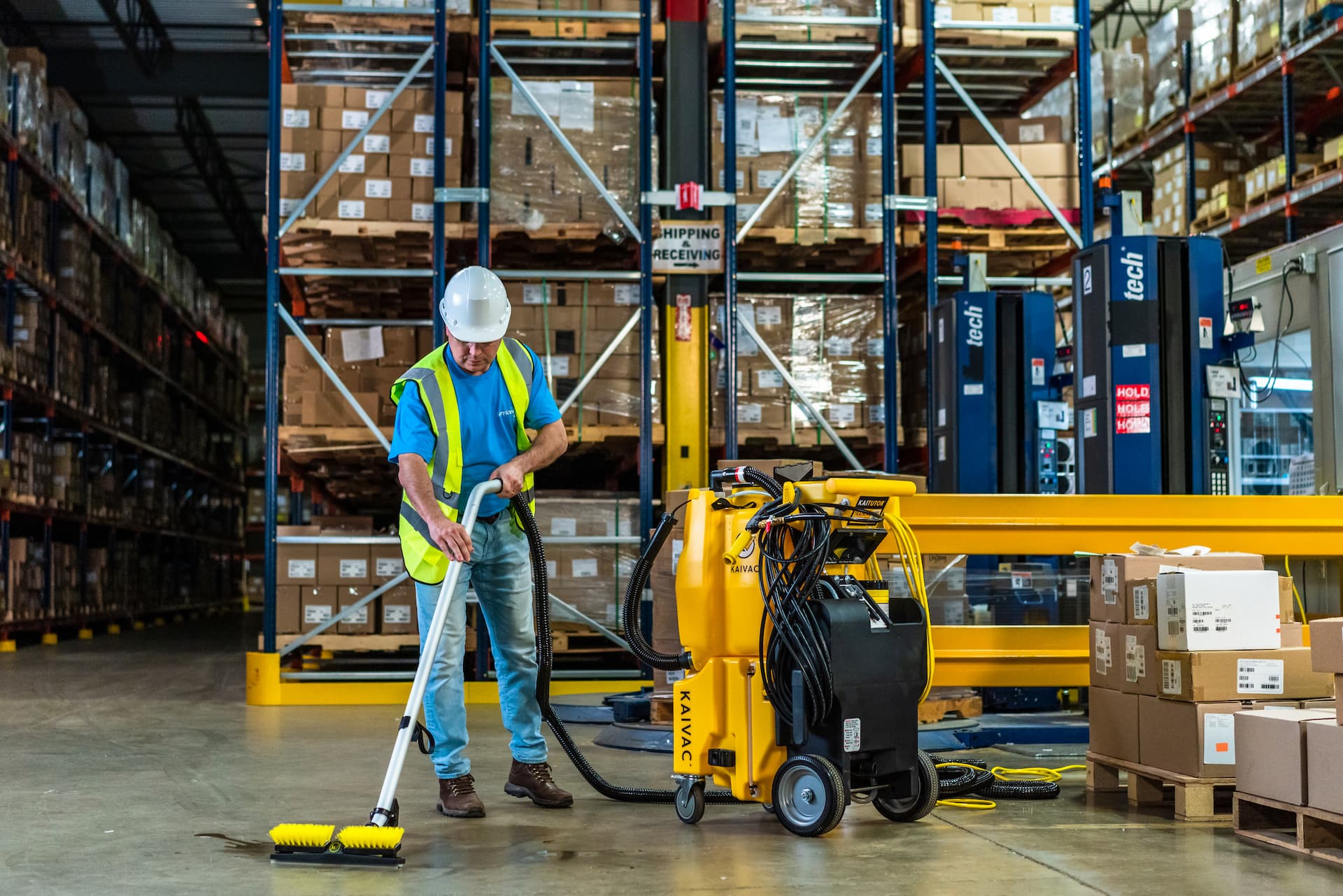
- Operating ride-on or walk-behind scrubbers
- Sweeping and mopping large floor areas (thousands of square metres)
- Emptying industrial bins and compactors
- Cleaning loading docks and bay areas
- Removing pallet debris and shrink wrap
- Cleaning break rooms and bathrooms (depending on contract)
- Following health and safety procedures (spill response, chemical handling)
Skills employers look for:
- Experience with industrial cleaning equipment (scrubbers, sweepers, pressure washers)
- Knowledge of cleaning chemicals and safe dilution (MSDS)
- Physical stamina (standing, walking, lifting up to 20 kg)
- Attention to safety (working near forklifts, moving vehicles)
- Reliability (warehouses can't operate if floors aren't clean)
Certifications that increase pay:
- Forklift licence (helps – you may move pallets to clean under them)
- Working at heights (if cleaning racking)
- Chemical handling certification
| Skill | Why Employers Want It | Pay Boost |
|---|---|---|
| Ride-on scrubber experience | Faster cleaning of large floors | +$2-$5/hr |
| Forklift licence | Can move pallets to clean underneath | +$3-$7/hr |
| Chemical handling cert | Safe use of industrial cleaners | +$1-$3/hr |
Part 5: How to Spot a Bad Cleaning Contract (Before You Sign)
Red Flag #1: "Start as a subcontractor, maybe become employee later"
You'll get no benefits, no guaranteed hours, and no workers' comp. If you're injured, you're on your own.
Red Flag #2: "You need your own ABN and insurance"
Legitimate employers provide workers' comp and public liability insurance. If you need your own insurance ($500-$1,500/year), your rate should be much higher.
Red Flag #3: "We'll pay you cash"
No superannuation, no tax withheld, no proof of income for loans or rental applications. Also illegal.
Red Flag #4: "No fixed hours – we'll call you when we need you"
Zero-hour contracts mean no guaranteed income. You could be called at 3 AM and expected to start immediately.
Red Flag #5: "Training is unpaid"
Illegal. Any required training must be paid at minimum wage.
| Red Flag | What It Means |
|---|---|
| "Start as subcontractor" | No benefits, no job security |
| "Need your own ABN" | You're responsible for your own tax, super, insurance |
| "Cash payment" | Illegal, no super, no proof of income |
| "No fixed hours" | Zero-hour contract – unreliable income |
| "Unpaid training" | Illegal – training must be paid |
Part 6: How to Find Warehouse Cleaner Jobs Near You
Step 1 – Update your resume
Highlight experience with industrial cleaning equipment (brands: Tennant, Nilfisk, Karcher). List any forklift or chemical handling certifications.
Step 2 – Search the right keywords
Don't just search "cleaner." Use:
- "Industrial warehouse cleaning"
- "Warehouse floor cleaning"
- "Distribution centre cleaner"
- "Sanitation technician" (food manufacturing)
- "Forklift cleaner" (rare but pays well)
Step 3 – Check these job boards
- Seek.com.au
- Indeed.com.au
- Adzuna.com.au
- APSjobs.gov.au (government warehouses)
- Company career pages (Amazon, Coles, Woolworths, Aldi, Linfox, Toll)
Step 4 – Contact labour hire companies
Some large warehouses hire through agencies. Examples: Programmed, ISS Facility Services, Spotless, Downer Group. Be aware – agencies take a cut, so your pay may be lower.
Step 5 – Ask about shift penalties
When you get an offer, confirm: "What's the base rate? What shift loadings apply for nights and weekends?"
| Search Keyword | What It Finds |
|---|---|
| "Industrial warehouse cleaning" | Heavy cleaning roles, higher pay |
| "Distribution centre cleaner" | Amazon, Coles, Woolworths DCs |
| "Sanitation technician" | Food manufacturing cleaning |
| "Warehouse floor cleaning" | General floor cleaning roles |
Part 7: Your Rights as a Warehouse Cleaner (Don't Let Anyone Tell You Otherwise)
Right #1: Minimum wage and penalty rates
Under the Cleaning Services Award 2020, you're entitled to minimum $24.10 per hour plus loadings for nights and weekends.
Right #2: Superannuation
Employers must pay 11.5% super (rising to 12% in July 2025) into your nominated fund.
Right #3: Paid leave
Permanent employees get 4 weeks annual leave, 10 days sick leave per year.
Right #4: Workers' compensation
If you're injured on the job, workers' comp covers medical expenses and lost wages. Subcontractors generally don't have this.
Right #5: A safe workplace
Your employer must provide PPE (gloves, boots, hi-vis, safety glasses, hearing protection). You cannot be charged for PPE.
Right #6: Written pay slips
Pay slips must show hours worked, rate, shift loadings, super contributions, and deductions.
| Right | What to Do If Denied |
|---|---|
| Minimum wage | Contact Fair Work Ombudsman (13 13 94) |
| Superannuation | Report to ATO |
| Paid leave | Fair Work Commission |
| Workers' comp | State workers' compensation authority |
| PPE | Refuse unsafe work |
Part 8: Frequently Asked Questions About Warehouse Cleaning Jobs
How much does a warehouse cleaner earn in Australia?
$24-$38 per hour depending on shift, employer, and employment type. Night shifts pay the most.
Do I need experience to be a warehouse cleaner?
Entry-level roles exist, but experience with ride-on scrubbers pays more. Some employers provide training.
What's the difference between industrial warehouse cleaning and office cleaning?
Industrial cleaning uses heavy machinery (scrubbers, sweepers), involves larger areas, and often happens at night. Office cleaning is lighter, uses mops and vacuums.
Can I work as a warehouse cleaner on a visa?
Yes – many warehouse cleaners work on working holiday visas or sponsored visas. Check your visa work conditions.
Is warehouse cleaning dangerous?
Working near forklifts and heavy machinery carries risk. Proper training, PPE, and safety procedures reduce risk significantly.
How do I become a warehouse cleaner with no experience?
Apply for entry-level roles through labour hire agencies. Highlight physical fitness, reliability, and willingness to learn. Some employers provide on-the-job training.
Part 9: Your Action Plan – Get a Better-Paying Warehouse Cleaning Job
Step 1 – Check your current pay (today)
Are you getting shift loadings? Overtime? Super? If not, you're being underpaid.
Step 2 – Update your resume (1 day)
Add equipment experience (ride-on scrubbers, sweepers). Add any certifications (forklift, chemical handling).
Step 3 – Search for better jobs (1-2 weeks)
Use the keywords from Part 6. Target large distribution centres (Amazon, Coles, Woolworths) and cold storage warehouses (higher pay).
Step 4 – Compare offers (1 week)
Don't accept the first offer. Compare:
- Base rate
- Shift loadings
- Superannuation
- Leave entitlements
- PPE provided
Step 5 – Negotiate
If you have experience, ask for $2-$5 more per hour. The worst they can say is no.
Step 6 – Leave your current job professionally
Give notice. Don't burn bridges. The cleaning industry is small.
Key documents to keep:
- Employment contract
- Pay slips
- Superannuation statements
- Training certificates